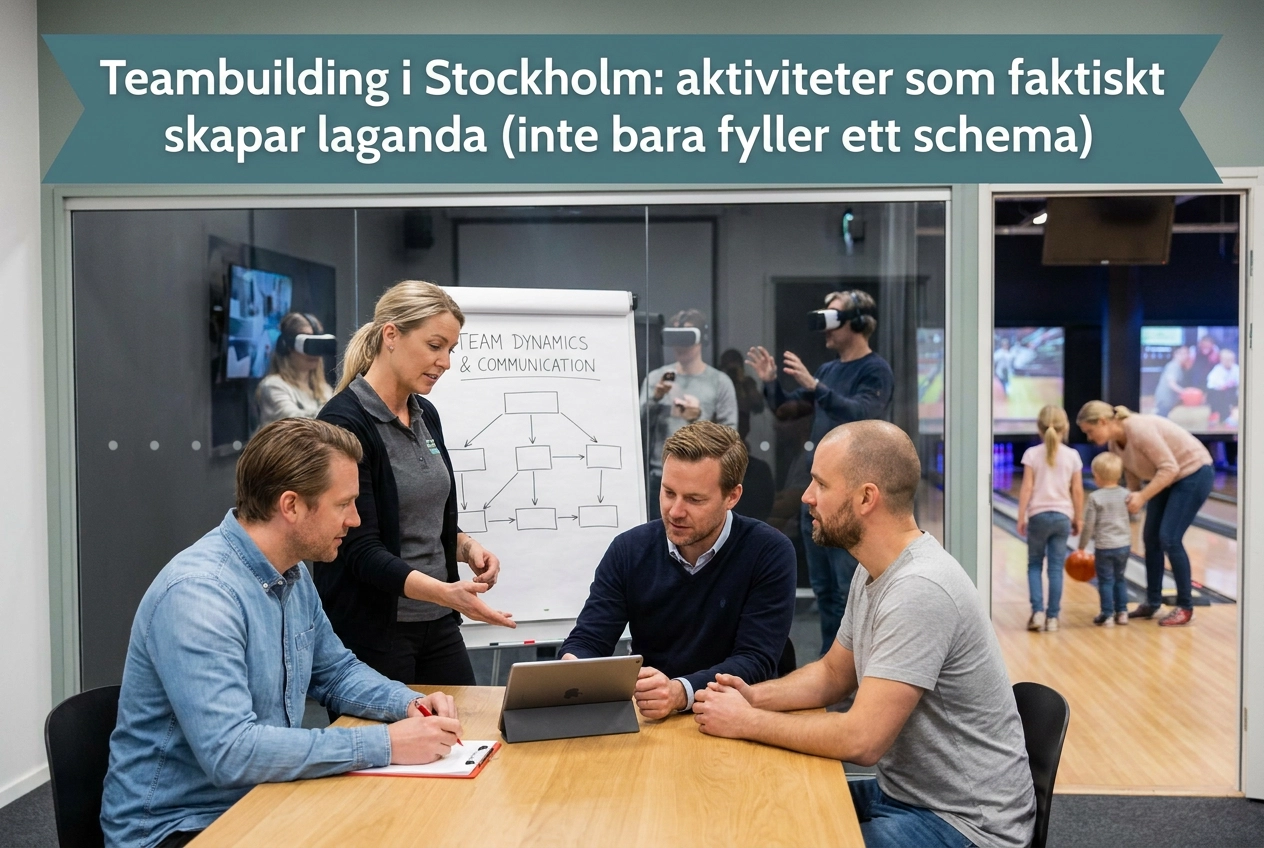
Team building in Stockholm: activities that actually build team spirit
Almost seven out of ten employees have been part of a dysfunctional team. Yet activity after activity is booked without the team dynamic changing much. It is not a problem of ambition, it is a problem of selection.
Team building in Stockholm is an industry full of fun experiences that deliver exactly what they promise: a nice afternoon. But research from Carnegie Mellon, MIT and Union College points to something more specific. What actually decides whether a team performs is social sensitivity and balanced communication patterns, factors that weigh as much as individual intelligence, personality and skills combined.
This guide takes a different approach. Instead of listing what is popular, we rank Stockholm’s most common team building activities against scientifically grounded criteria for team dynamics. You will find out why traditional team building rarely creates lasting effects, how indoor and outdoor formats differ, which mistakes are most common and how to justify your choice to management with arguments that hold up. Welcome to a guide that helps you choose with intent.
Why traditional team building rarely creates lasting team spirit
Despite billions spent on team building around the world, surveys show that 68 percent of employees have been part of a dysfunctional team, and only 24 percent actually prefer working in teams. The figures don’t suggest that people are bad at working together; they suggest that most team initiatives don’t deliver what they promise.
As described in the introduction, research from Carnegie Mellon, MIT and Union College identified social sensitivity and evenly distributed communication patterns as the two qualities that consistently set high performing teams apart from the rest. A quasi experimental study of Swedish government agencies gives a further warning sign: team building interventions mainly affected GDQ scale IV, that is teams already in a mature phase, but showed no significant effect on scales I to III. So the effect is selective, not universal. The same activity can be meaningful for a well functioning team and completely ineffective for a team with fundamental collaboration problems.
The core of the problem is the selection process. Most team building activities in Stockholm and the rest of Sweden are chosen on two criteria: entertainment value and logistical simplicity. Those are understandable priorities for a stressed organiser with a date to fill, but they have no link to the behaviours research has identified as decisive. A day of paintball or a digital quiz can put everyone in a good mood on the bus home, but it trains neither social sensitivity nor more even conversation patterns, and therefore leaves no trace in how the team works at the next Monday meeting.
It is that distinction, between activities that entertain and activities that actually change behaviour, that this guide is built around.
How we assess the activities: three scientifically grounded criteria
Since entertainment value is an unreliable measure, each activity needs to be assessed against criteria that actually predict an effect on the team. This guide uses three such criteria, grounded in team research from MIT and the Belbin framework, among others.
Criterion 1: Social sensitivity
Social sensitivity measures the extent to which an activity requires participants to actively read each other’s signals, adapt in real time and respond to emotional cues. Research on emotional competence in team leadership confirms that active listening and self regulation are fundamental mechanisms behind functioning teams, not nice extras. An activity that doesn’t require participants to interpret each other simply doesn’t train that ability.
Criterion 2: Communication patterns
It is not enough for a team to talk to each other; what matters is how the floor is shared. Activities that structurally amplify voices that already dominate reproduce the communication problems you want to solve. This criterion measures whether the format actively helps quiet team members be heard, lets initiative change hands and stops any single person from driving the conversation. Belbin’s research shows that balanced roles reduce conflict and increase psychological safety, which requires the activity to leave room for complementary contributions.
Criterion 3: Lasting transferability
The third and most demanding criterion is whether the behaviours the activity trains actually show up in everyday work weeks later. Tuckman’s model highlights that teams tend to focus on the content of the task and neglect process and feelings, which explains why a strong team day can leave minimal traces if the behaviours are not identical to the daily work.
How the framework is used in this guide
Each activity below is given a rating, low, medium or high, on all three criteria. That makes it easy to point to exactly why a choice is justified to management or the board, instead of arguing that “people usually like it”.
The framework also allows strategic combinations. An outdoor activity with a high score for social sensitivity can be paired with a follow up workshop that consolidates the communication patterns, since according to Tuckman norming needs to come before performing for the effect to last.
Indoor team building activities in Stockholm: what research says about each format
With the criteria in place, it is time to apply them to the most common indoor options for team building activities in Stockholm.
1. Escape rooms
Time pressure forces participants to share information quickly and listen actively, which gives a high score for social sensitivity. The weakness is structural: experience shows that strong problem solvers often take the lead, a risk to consider if you choose one without a debrief. The communication pattern criterion therefore falls short, unless the organiser adds a structured debrief afterwards.
2. Cooking classes and culinary workshops
In practice, changing roles tend to be built into the format: someone chops, someone leads, someone seasons. That creates moments of collaboration without a formal hierarchy. The risk is that the tasks are simple enough that the group never has to solve a real problem together, and without structured reflection the experience stays at the feel good level rather than cementing new communication patterns.
3. Improv theatre and stage exercises
This is the strongest indoor format on scientific grounds. Improv requires every participant to be an active listener and sender at the same time. The format resembles the communication principles identified by MIT as decisive for effective team communication: receiving, processing and giving feedback in real time. Nobody can passively wait for their turn, which makes the format especially valuable for teams where quiet voices are rarely heard.
4. Workshop based activities with an external facilitator
Design thinking, decision exercises and problem solving linked to real business challenges have good potential for lasting transferability. The logic is simple: the behaviours being trained resemble the actual work. The team practises sharing the floor, questioning assumptions and reaching decisions under uncertainty, just like in next week’s meeting.
5. Digital quizzes and trivia formats
The entertainment value is obvious, but the format offers limited opportunities to train social sensitivity or communication patterns. Participants sit with their own device, compete for the right answer and never have to read a colleague or adapt their behaviour. Psychological safety and deeper togetherness are not built in a leaderboard format.
Rule of thumb: the more the activity requires participants to respond to each other in real time, the higher it ranks on the three criteria.
Outdoor team building activities in Stockholm: the parks, the archipelago and what they actually train
The outdoors changes group dynamics in ways a conference room can’t replicate, but it doesn’t guarantee that the right behaviours are trained.
1. Orienteering on Djurgården or in Hagaparken
Orienteering exercises create natural situations where map reading, quick decision making and tactical communication are shared organically within the group. When the terrain decides who leads, rather than the job title on the business card, more even conversation patterns emerge. Different team members take the lead at different checkpoints, which directly counteracts the patterns of dominance that otherwise lock up communication in everyday meetings.
2. Kayaking and boat activities in the archipelago
Kayaking in pairs creates natural situations that require synchronisation without words, a format that can activate the kind of non verbal communication research points to as decisive for high performing teams. Reading a colleague’s body language and paddle rhythm under pressure is a transferable skill, provided the experience is linked to concrete work situations afterwards.
3. Competitive sports: a double edged activity
Paintball, football tournaments and similar competitive formats are popular outdoor team building activities but carry a built in risk. Clear winners and losers risk mirroring the existing status structures in the group. Those who already stand out at work tend to do so here too, which can reinforce rather than challenge the hierarchy. If you choose a competitive format, plan structured reflection immediately afterwards. Without it you risk the activity setting your team dynamic back instead of developing it.
4. City walks with collaborative tasks
As an activity with work colleagues in Stockholm, the city walk is unbeatably budget friendly and inclusive. Everyone can take part, the logistics are simple, and Stockholm’s urban setting offers natural places to talk. Even so, it only ranks medium high. Without a clear task structure the walk risks becoming pleasant company rather than training in communication patterns. Link the tasks to concrete decision situations and the value rises markedly.
5. Outdoors: high experience, lower durability
There is a systematic difference between how the team feels straight after an outdoor day and what actually sticks weeks later. Outdoor formats deliver strong short term togetherness; the lasting effect is decided by the reflection that ends the day and by how well the experience is linked to everyday work afterwards.
The next section ranks all the formats, indoor and outdoor, against each other with an overall rating per criterion.
Ranked list: team building activities in Stockholm sorted by team dynamic value
Using the criteria above as a yardstick, it is possible to rank Stockholm’s most common team building formats in a way that can actually be defended in a management meeting.
1. Goraidag.se’s experience packages for companies in Stockholm The top spot is justified because the selection is hand picked for those who want to see the real Stockholm, with a focus on activities that create more than a scheduled date in the calendar. That makes it possible to match the activity to the team’s actual needs, rather than choosing on entertainment value. That is the logic most alternatives lack.
2. Improv theatre with a professional facilitator The highest overall score on all three criteria among the standalone formats. The exercises require active listening, immediate response to social signals and for every participant to be as active a sender as a receiver, which makes the format especially effective for teams where a few voices dominate meetings. For inspiration on activities that push the comfort zone, see also how climbing trains teamwork for all levels.
3. Facilitated workshops linked to real business challenges Strongest on lasting transferability because participants train behaviours that are identical to the actual work. It is also the format that is easiest to justify with concrete business value to a management team, as the link between the activity and the organisation’s goals is direct, not metaphorical.
4. Escape rooms with a structured debrief Escape rooms without a debrief end up in the middle of the field. With structured reflection straight afterwards the picture changes, because the debrief decides whether the experience consolidates a communication pattern or just stays a memory. Choose an organiser who includes it as standard, not as an extra. Curious about the escape room format? Read more about what it actually demands of a team.
5. Kayaking and archipelago activities Strong on social sensitivity and non verbal communication in real time, which is genuine value. The weakness is lasting transferability: the behaviours activated on the water rarely reappear in the office without an explicit follow up that ties them together. Combine with a short workshop or check in afterwards for the full effect.
Lowest ranked: competitive sports without reflection and digital quizzes These formats are entertaining but consistently train the wrong behaviours. Competitive formats risk mirroring existing hierarchies rather than levelling them. Quizzes activate individual performance, not shared problem solving. None of them address social sensitivity or evenly distributed conversation patterns. For those who still want a physical challenge with clearer moments of collaboration, climbing is an option that actually requires joint decision making.
How to justify your choice of team building activity to management
Once you have chosen an activity, the hardest step often remains: selling it to your manager or the management team. Here are five concrete arguments that work.
1. Link the activity to a specific behaviour you want to change
Don’t start with the name of the activity, start with the problem. Identify a concrete team behaviour that causes friction today, for example decisions getting stuck in meetings or unclear responsibilities. Then show how the activity’s format directly trains exactly that behaviour. “We are choosing improv theatre because it requires everyone to listen actively and respond in real time, and that is exactly what we need in our status meetings” is a much stronger argument than “it is usually fun”.
2. Use the GDQ framework as a reference
Research shows that teams go through clear development phases, and that the right activity at the right phase gives a measurable effect while the wrong activity is a waste of time and budget. A study of Swedish government agencies showed that team building interventions had a significant effect on GDQ scale IV but not on the lower scales, which confirms that activities must be matched to the team’s current phase. That argument resonates with decision makers who want to see the money used well.
3. Present communication patterns as a business critical factor
As mentioned earlier, a team’s internal communication patterns weigh as much as individual skills, personality and the content of discussions combined. That turns team building from a social cost into a strategic investment in productivity. Put it like this to management: you are not investing in a fun day, you are investing in the communication pattern that decides how quickly the team makes good decisions.
4. Propose a follow up measurement straight away
End the presentation with a concrete proposal for how you will measure the effect. As a rule of thumb, a follow up conversation about four to six weeks after the activity is recommended, with three questions on communication, clarity of responsibility and constructive handling of conflict. It shows you are serious about ROI and pre empts the most common objection: “How do we know it achieved anything?”
5. Avoid fun as the main argument
Management doesn’t buy “everyone usually thinks it is fun”. They buy “we are choosing this format because it trains X, and we will measure it with Y”. The rest of the arguments above give you exactly that language.
What happens after the activity decides whether it actually makes a difference
Choosing the right activity is only half the job. The other half is decided by what happens in the 30 minutes straight afterwards.
A meta analysis of 46 studies by Tannenbaum and Cerasoli shows that teams that carry out a structured debrief perform more than 20 percent better than teams that don’t. That is a large effect for a simple intervention, and the main reason debriefs don’t happen is not a lack of time in theory but that the leader never sets aside time in practice.
A three step model for a debrief on the spot
Ask the team three questions immediately after the activity, before everyone starts picking up their coats and checking their phones:
- What did you notice about how you communicated? Opens up for observation without blame.
- What worked unexpectedly well? Locks a positive behaviour into the collective memory.
- One concrete behaviour we take with us into everyday work. Agree on one, not five.
The whole session takes 15 to 20 minutes. It is the difference between a fun day and a day that actually changes something.
The follow up weeks later
Behaviour change needs repetition to become a habit. As a rule of thumb, a follow up conversation about four to six weeks after the activity is recommended. Book it at the activity itself, 20 to 30 minutes, where the team comes back to exactly the behaviour you identified. Link the discussion to concrete situations that have happened since: a meeting where the communication pattern was tested, a decision that got complicated or an occasion where it actually worked better than before.
Combine experience and consolidation
Outdoor activities in Stockholm, kayaking in the archipelago, orienteering in Haga or on Djurgården, activate social sensitivity and non verbal communication in a way that is hard to replicate indoors. But the power of an experience and lasting transferability are not the same thing. Combine a strong outdoor experience with an indoor follow up session, a short workshop or facilitated discussion, where the communication patterns activated during the day are turned into concrete working routines.
The model also makes it easier to show the effect to management, as a simple before and after comparison gives concrete grounds for further investment.
Five common mistakes when companies book team building activities in Stockholm
Knowing what happens after the activity is one thing. Avoiding the traps when you book is another. Here are the five mistakes that consistently sabotage team building activities in Stockholm before the day has even begun.
1. Choosing by trend, not by the team’s actual needs
Escape rooms are popular right now. So is padel. But a team in an early formation phase needs completely different behavioural exercises from a mature team with ingrained but destructive communication patterns. As the GDQ research (described above) shows, team building interventions have a selective effect; they don’t train all stages of development at once. If you choose the wrong format for the team’s current phase, you train the wrong behaviours, however fun the day is.
2. Prioritising entertainment value over collaboration value
A day everyone remembers with a smile is not the same as a day that changes how the team works in Monday’s meeting. The critical strand of Swedish team building research asks exactly this question: can the effect be measured at all, and how long does it last? If the activity is chosen only because “it is usually fun”, the answer is usually no.
3. Skipping the reflection to make it to lunch
This is the most common and most costly mistake. Lack of time is the most common reason, but the consequence is that the whole investment is reduced to a nice day with no lasting effect. See the debrief section above for the structured three step model.
4. Confusing a social activity with strategic team building
A city walk or after work in Stockholm can strengthen relationships and lower barriers, and that is genuinely valuable. But it is not the same as strategic team building with defined learning goals. The two formats can complement each other, but they are not interchangeable. Calling an after work team building in front of management undermines the credibility of the whole initiative.
5. Using the same format regardless of group size
A format that creates deep communication in a team of eight can become shallow and unstructured for a team of twenty. Larger groups need clearer facilitation, smaller breakout groups and more structure to make sure all voices are actually heard, not just the most dominant ones. Without that adjustment the activity risks reinforcing existing hierarchies rather than challenging them.
Choose your activity with intent, not out of habit
Avoiding the mistakes is one step. Actively choosing the right thing is the next.
With social sensitivity and evenly distributed communication patterns as guiding criteria (see the introduction), it is possible to make a choice that can actually be defended, both to management and afterwards when the effect is evaluated.
Checklist before booking
Go through these four questions before you confirm:
- Which team behaviour do we want to strengthen? Name it concretely, not “better team spirit” but “clearer listening in meetings” or “more voices in the decision process”.
- Does the activity train that behaviour directly? If the answer is no or maybe, choose another format.
- Have we planned a debrief and follow up? Without reflection the experience risks staying a fun memory with no impact on everyday work.
- Can we justify the choice with a concrete business reason? That is the difference between a budget item that gets questioned and an investment that defends itself.
Next step
Goraidag.se lists hand picked team building activities in Stockholm for companies, with a focus on experiences that create more than a scheduled date in the calendar. The selection is made with collaboration value as the starting point, not just entertainment.
Browse the activities, identify the format that matches the team’s actual needs right now and book with the arguments already worked out. When management asks why you chose that particular activity, you have the answer ready: not because it is usually fun, but because it trains exactly the behaviour the team needs to develop now.
That is the difference between team building that fills a schedule and team building that actually builds a team.
Conclusion
Good team building is not about booking something that “usually works” but about choosing with intent. The key insights from this guide: the activity must train a concrete team behaviour, the debrief and follow up are at least as important as the experience itself, and you need to be able to justify the choice with a business reason before you book.
Stockholm offers a wide range of formats, both indoors and outdoors. What separates a memorable activity from one that actually makes a difference is the intention behind the choice.
Use the checklist, identify the team’s real needs right now and choose the format that trains exactly that. Then book with the arguments already in place.
Team building that builds real teams starts with the right question: what do we need to get better at?