Corporate events in Stockholm: choose the activity by purpose, not taste
Every year HR managers and event planners all over the country spend hours comparing activities, reading reviews and asking for quotes, only to realise afterwards that the event didn’t quite land as intended. Not because the activity was bad, but because it didn’t match what the group actually needed at that moment.
When it comes to corporate events in Stockholm, the choice is enormous. Escape rooms, wine tastings, paintball, cooking classes, city hunts, ziplines. The problem is rarely finding something to do. The problem is starting with the wrong question.
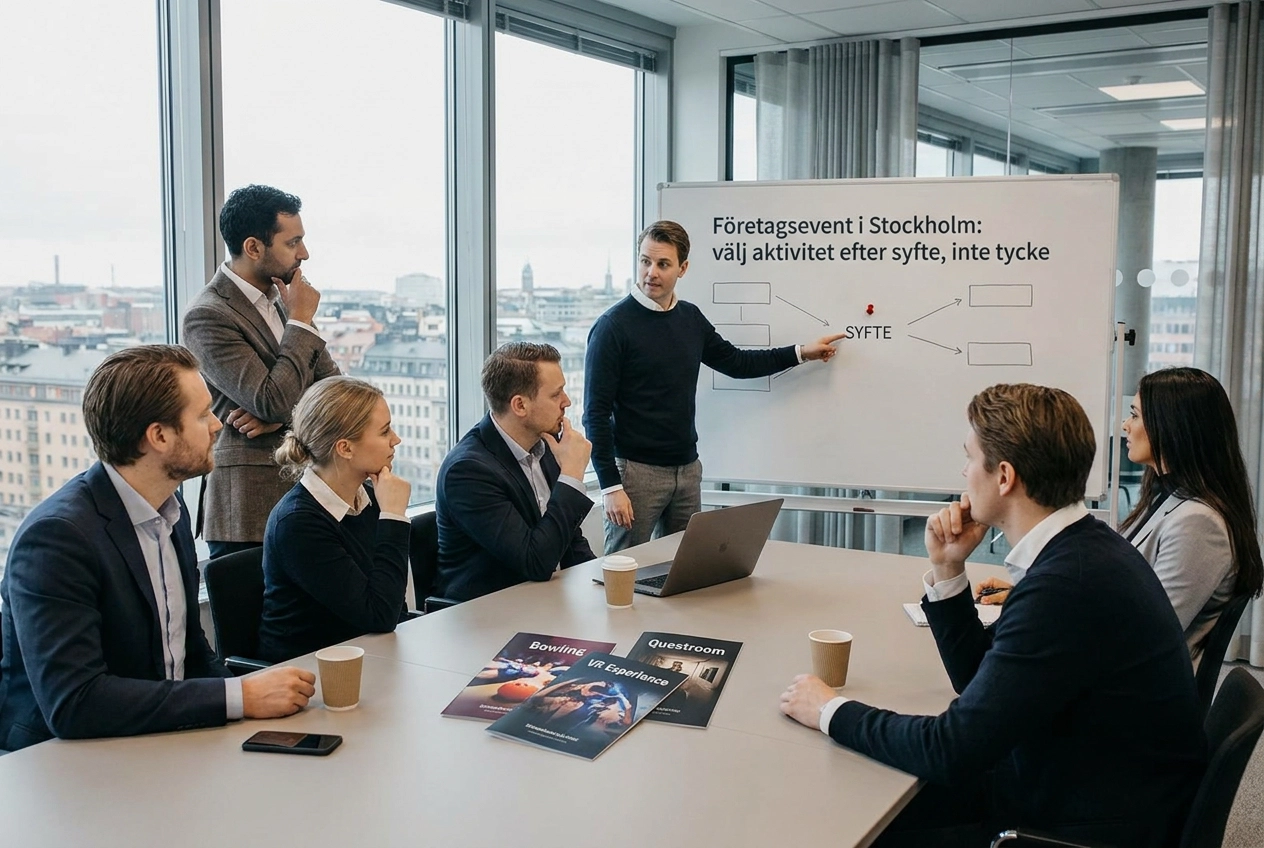
This guide turns the decision process around. Instead of asking “which activity should we choose?” we start with “what outcome do we want?” It is a small change in perspective, but it makes all the difference. You will learn how to tell team building, celebrations and a relaxed after work apart, why they need completely different activities, and how to avoid the most common pitfalls that otherwise cost both time and budget. In short: a practical guide from purpose to booking.
Why the wrong activity can’t rescue a poor purpose
Most people planning a corporate event in Stockholm start with the same question: what should we do? But that question almost always leads you astray. The right question is: what do we want to achieve? The difference decides whether the event actually delivers anything beyond a nice evening.
The symptoms of activity focused thinking are easy to recognise. Everyone votes for an escape room because it sounds fun, but nobody has put into words why the group needs it. Or the boss chooses paintball because they personally like action, not because the group has a collaboration problem that calls for that format. The result is an event that is fun in the moment but leaves no trace afterwards.
The problem is not the choice. The range of corporate events in Stockholm is wide, with activities for every group size and budget. What you can easily lack, on the other hand, is a framework for choosing the right one among them.
Whatever the ratings, one thing is clear: without a defined purpose it is hard to know whether the event actually reached its goal. That purpose has to be locked in before you open a supplier catalogue, not afterwards.
Three purposes that drive the whole choice of corporate event
So which category suits your group? There are three basic purposes, and they need completely different approaches.
Purpose 1: Strengthen collaboration and communication
This is the right purpose when the group has a real problem to solve, not when everyone just wants a nice day. Newly formed teams, departments that have just been through a reorganisation, or groups where communication is sticking need an event that actively works on the group dynamic. The goal is behaviour change, not entertainment.
Purpose 2: Celebrate a result or a milestone
Celebration is about acknowledging and rewarding something the group has already achieved. The activity is a symbol of the achievement, not a tool for changing anything. If you choose celebration as the purpose, participants should feel seen and appreciated, not assessed or challenged.
Purpose 3: Socialising and the after work format
Informal socialising aims to lower the threshold for spontaneous contact across departments and levels of hierarchy. There are no measurable outcomes to chase. The goal is togetherness and enjoyment, and that is more than enough.
Why mixing purposes kills the energy
Many corporate events fail because the organiser mixes these three. Team building exercises in the middle of a celebration feel forced. Results presentations during an after work kill the mood instantly. Every element signals a purpose, and conflicting signals confuse the group.
Ask your group this question before you look at a single activity: What should be different after the event? The answer reveals exactly which of the three purposes actually applies.
When team building is the right choice for your company activities in Stockholm
If the answer to “What should be different after the event?” is about how people collaborate, communicate or trust each other, team building is the right track.
Team building fits when the problem is concrete and identifiable. New recruits who haven’t found their role, silos where departments don’t talk to each other, low trust after a reorganisation. Without a problem like that to solve, team building is just entertainment with a fancier name.
Activities that actually deliver
Three formats work well for team building purposes in Stockholm:
- Escape rooms train communication and collaboration under time pressure. They suit a few participants per room, perfect for department workshops.
- Adventure education with ropes courses and ziplines puts the group in situations where support and trust are really tested.
- AR based city hunts scale up to 350 participants, suitable when the whole company is taking part. If you want something calmer, a beer tasting in Stockholm’s urban setting can provide a relaxed framework for conversation between colleagues who rarely meet.
The activity is a tool, not the goal
The critical step is what happens after the activity. A serious supplier builds in structured reflection and a debrief that link the experience to concrete behaviour at work. Without that part, however much fun it is with paintballs and adrenaline, it is just a fun moment. Research from Swedish government agencies confirms that team building has a measurable effect on group development, but only when the intervention is well thought out and followed up.
The most common mistake is to book team building once a year as a sticking plaster. The effect is short lived if the behaviour change isn’t maintained in everyday work afterwards.
When the celebration should be at the centre of the corporate event
Celebration fits when something concrete is done: a quarterly target has been reached, a product launch has been completed, an anniversary is to be marked or a big project has been landed. The activity is not a tool for change but an expression of gratitude and recognition. That is an important distinction.
Activities that suit a celebration
Choose formats that invite rather than challenge:
- A wine tasting or gala dinner gives a relaxed yet prestigious feel, suitable when the group deserves something a little extra
- A group cooking class is social and creative without anyone having to perform, which keeps the threshold low for every participant
- Seasonal packaged events such as Christmas parties, summer festivals or Oktoberfest deliver atmosphere and togetherness with minimal planning on your part
Rule of thumb: a gift or a task?
If the activity requires participants to compete or perform for it to work, it is team building in another wrapper. A celebration should feel like a gift to the group, not yet another task. More freedom of choice, less structure and room for spontaneous conversation is the right direction.
Suppliers offering ready made seasonal packages combine logistics and atmosphere in one and the same package, which saves time for the planner. You don’t have to build the evening from scratch and can focus on actually taking part in the celebration with the group.
When a relaxed after work really is the best choice
An after work is different from a celebration: here the goal is simply to be people together, with no agenda. It is exactly this lack of agenda that many HR managers get stuck on. It feels hard to justify the cost without a clear “purpose”. But research on social capital in the workplace shows that trust and togetherness are created in social relationships, and that they are a direct prerequisite for employees to work together effectively. An after work is not wasted time; it is maintenance of the glue that holds the group together.
The right time for the after work format
An after work works when the group is already doing well and needs a social recharge, not an intervention. If there are unresolved conflicts or structural collaboration problems, a relaxed evening is not enough; then you need team building with a debrief. But for a well functioning group, an after work is often exactly the right dose.
Activities that suit the format: wellness such as sauna or yoga, low threshold sports such as mini golf or boules, and simple outdoor experiences in Stockholm’s parks or archipelago. What they have in common is that nobody has to perform.
Keep it unstructured
The most common mistake is filling the after work with activities, presentations or round table discussions. Then it stops being an after work. Freedom and unplanned chat are the whole point; don’t schedule them away.
Budget perspective
The after work format is often the cheapest and quickest to put together. Shorter lead time, simpler logistics and lower cost per person than both team building and big celebrations, without losing value.
A practical decision framework: from purpose to booking
Now that you know which purpose applies, it is time to turn it into a concrete decision. Here are five steps that take you from insight to booking.
Step 1: Define the purpose with three questions
Ask the questions: What should be different after the event? Is it a response to a problem or a reward? Is attendance compulsory or voluntary? The answers point clearly to one of the three purposes, team building, celebration or after work, and save time in every step that follows.
Step 2: Filter by group size
The Stockholm market covers activities for 10 to 350 participants. Escape rooms suit a few people per session; city hunts and Gamla stan competitions scale up to 350. Group size quickly crosses a large number of options off the list.
Step 3: Match the format to the practical constraints
Decide on indoors or outdoors (outdoor activities in November need weather protection and a backup plan), half day or full day, and whether catering and conference facilities should be included in the same booking. Sorting out these constraints early prevents costly late changes.
Step 4: Choose the right type of supplier
- Full service agencies suit you when you want a single point of contact and one invoice.
- Activity specialists suit you when you already know exactly which type of activity you are looking for.
- Aggregators suit you when you are still comparing options and need a broad overview.
Step 5: Check reviews and reference cases
Suppliers with 4.3 to 4.7 stars and a substantial number of reviews have a track record to evaluate. Always ask for reference cases from groups of a similar size and purpose, not just general satisfaction figures.
Four common pitfalls when planning corporate events in Stockholm
Even with a clear framework there are mistakes that come up again and again in the planning of corporate events in Stockholm.
The boss decides based on personal preference. Paintball for the adventure loving boss, wine tasting for the foodie. The result is an event that reflects one person’s taste rather than the group’s needs. The solution is simple: involve the group in the needs analysis before any activity is even discussed.
Mixed purposes in the same event. Team building exercises in the middle of a celebration send the signal that the celebration is really a work session. Results presentations during an after work kill the mood. Every element you add communicates something about what the event is really about, so keep the purpose clean.
The logistics of group size are underestimated. An activity that works perfectly for 15 people can become chaotic for 60. Always check the maximum capacity and ask the supplier concretely how they handle large groups, not just whether they “can take” them.
Team building without a debrief. An adventure education activity without structured reflection afterwards is in practice just a fun outing. Good suppliers build in reviews that link the activity to real workplace behaviour. If that part is missing, you should either demand it or choose a different purpose for the event.
If you want to read more tips on finding the right experience for the group, check out more guides to activities in Stockholm.
Find the right company activity in Stockholm without guessing
Once you avoid the pitfalls, the next challenge is to actually find the right activity without drowning in supplier catalogues.
Goraidag.se collects hand picked company activities in Stockholm, from paintball and escape rooms to cooking and wine tasting, sorted by type of activity, group format and atmosphere. Instead of searching through hundreds of suppliers, HR managers and event planners find guides that already start from what actually suits different groups and occasions.
The tips cover the whole range, from intimate dinners for a small department team to large scale city events for the whole company. Each activity is presented with concrete details about what it requires of the participants, not just what it is called.
How to use the site as an orientation tool:
- Start with the purpose you have defined, not with the name of the activity
- Browse guides sorted by format and group type
- Identify three to five activities that match the purpose
- Take those options to the suppliers and ask for quotes and reference cases from similar groups
If you want more inspiration, you can also explore what you can do today in Stockholm or read about cooking as a group activity, a format that works just as well for celebrations as for relaxed socialising.
Start with why, not what: summary and next steps
Now that you know where to find inspiration, it is time to actually make the decision. And it doesn’t start with an activity catalogue.
Lock in the purpose first. Team building, celebration and socialising are three fundamentally different assignments. An escape room can be the right tool for a collaboration problem but the wrong signal at a celebration. Decide on the purpose before you look at a single option.
The five steps in the framework above take you from purpose to booking, and the four pitfalls point out what most often goes wrong along the way.
The next concrete step is to write down the three key questions and send them to the group or the management team before you open a single catalogue:
- What should be different after the event?
- Is it a response to a problem or a reward?
- Is attendance compulsory or voluntary?
The answers point to the right purpose. The right purpose points to the right activity.